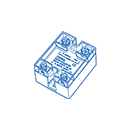

Solid state relays (SSRs) and electromechanical relays both let a control signal switch a load, but they behave differently in a control panel. The choice depends on the load, switching pattern and failure requirements, not just the current printed on the device.
An electromechanical relay moves contacts with a coil. An SSR uses semiconductor devices and has no moving switching contacts. Mechanical contacts provide a physical separation when open, subject to the relay design and contact condition. An SSR can conduct a small off-state leakage current, so “off” may not mean a fully isolated output.
Frequent switching produces mechanical wear in a contact relay. An SSR avoids contact wear and can suit repetitive control, such as some temperature-control circuits. Electrical life still depends on load conditions, thermal design and protective devices. Compare the actual operating profile with the model datasheet rather than assuming either type has unlimited life.
An SSR dissipates heat while carrying current. Its heat sink, airflow and enclosure temperature can determine the usable load current. A mechanical relay may use power in its coil and can create contact arcing during switching. Include terminal clearance, service access and any required protection in the panel layout.
Confirm AC or DC output, voltage, current, inrush and whether the load is resistive, inductive or capacitive. For AC SSRs, zero-crossing and random turn-on operation serve different switching needs. Sensitive or very small loads may be affected by SSR leakage; high-inrush loads need careful device and protection selection whichever relay type is used.
Check the available input signal, response timing and what the equipment must do after a switching fault. Neither a standard SSR nor a standard electromechanical relay should be treated as a complete safety function by itself. Where isolation or safety control is required, design and verify the complete circuit to the applicable equipment requirements.
Start with the XURUI solid state relay range and the SSR selection guide. Provide the load type, voltage, running and starting current, switching frequency, ambient temperature and control signal when requesting model matching.