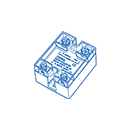

An AC solid state relay can pass a small current even when its control input is off. This is called off-state leakage current. With a heater, that current may have no visible effect. With an LED indicator, a small electronic power supply or a sensitive input, it can be enough to cause a faint glow or an unexpected voltage reading.
This does not automatically mean the SSR has failed. The first step is to compare the load with the off-state leakage current and minimum load current stated for the exact relay model.
An SSR uses semiconductor devices rather than mechanical contacts. Its output circuit may also include components that suppress electrical transients. As a result, “off” does not necessarily mean a complete physical break in the circuit.
A high-impedance multimeter may display voltage across an unloaded or lightly loaded output. A voltage reading alone does not show how much current the circuit can deliver. Check the actual load behavior and the model datasheet before diagnosing a fault.
Some SSRs require a minimum load current for the specified switching behavior. A relay chosen only by its maximum current rating may therefore be a poor match for a very small load.
For example, the XURUI XSSR-W1 product page lists an output leakage current of ≤5 mA and a minimum load current of 0.08 A. The XSSR-W2 page lists ≤8 mA leakage and 0.1 A minimum load current. These are series specifications; confirm the exact part number and operating conditions before selecting either model.
| Selection question | Information to check |
|---|---|
| Does the load glow or respond while off? | Load type, input sensitivity and the SSR’s specified off-state leakage |
| Is the load very small? | Operating current compared with the SSR’s minimum load current |
| Does the relay switch an AC or DC circuit? | Output type and the load’s voltage and current |
| Does the issue occur only in the installed machine? | Wiring, parallel circuits, indicator lamps and measurement method |
Record the exact SSR model, load type, load voltage and measured operating current. Check whether the load is an LED lamp, an indicator module, a controller input or another electronic device. Then compare those values with the relay’s output specifications.
Do not choose a resistor or another workaround based only on a generic online example. Any circuit change must be assessed for power dissipation, insulation, heat and applicable electrical requirements by a qualified person. In some applications, selecting a different switching device is the better solution.
When asking XURUI to recommend an SSR, provide:
AC or DC load, operating voltage and normal current.
Load type and any starting or inrush current.
Available control signal and required switching frequency.
Whether an LED, electronic input or other small load remains connected when the SSR is off.
Mounting arrangement, enclosure temperature and available heat sink.
Browse the XURUI solid state relay range or send the application details for a quotation. The exact relay should be selected against its model-specific datasheet.
Not by itself. A small specified leakage current is normal for many SSR designs. Compare the measured behavior with the exact model’s specification. An output that conducts substantial load current with the control input off needs separate diagnosis.
Possibly, but a low-power LED may glow faintly from off-state leakage or fall below the SSR’s minimum load requirement. Check both values before selecting the relay.
No. Maximum current rating does not establish suitability for a small load. Minimum load current, leakage current and output type are also relevant.
Send the SSR part number, the load’s voltage and normal current, a wiring diagram and a description of the observed off-state behavior.